

How many steps should you take each day?
One step at a time

The journey to good health starts with a single step. How many steps do you need to take after that?
Folklore has it that 10 thousand steps per day is required for good health. But it turns out that that number was only chosen because it was a nice round number, to help promote an early pedometer.
Recall that on average, there are about 2 thousand steps in a mile, and average brisk walking speed is about 3 miles an hour. Do we all need to walk 5 miles each day?
The Lancet journal published a meta-analysis of studies connecting the number of daily steps to various health outcomes. The results are enlightening.
I focus on all-cause mortality as the primary outcome of interest. As with statins, hormones, cholesterol, and various other biomarkers, it doesn’t make sense to reduce the mortality risk for one disease only to increase it for another.
The researchers calculated the risk of dying for any reason associated with people who take a certain number of steps each day. They chose 2 thousand steps daily as a convenient reference point, the number of steps one would take walking around the house on a slow day, with no exercise. The risk of dying was then converted into a hazard ratio. Here are the results.
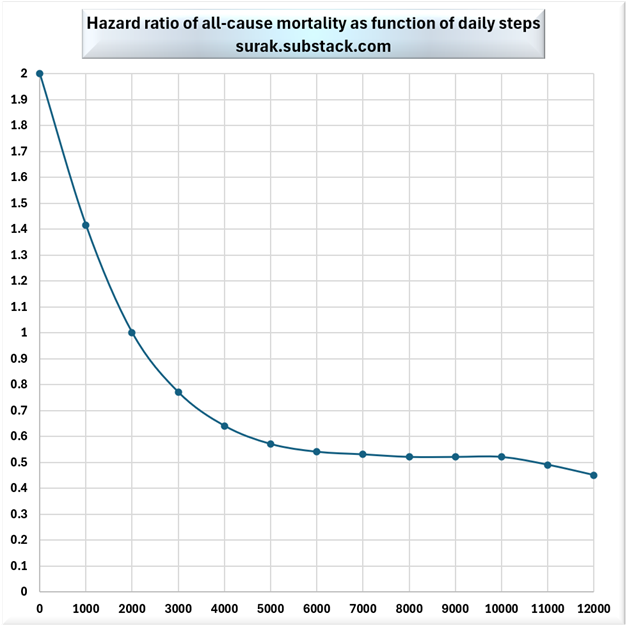
Someone who takes 3 thousand steps per day has already reduced the risk of dying by 23%.
Moving from 3 thousand to 4 thousand steps per day reduces the risk of dying an additional 13%, which is about 17% in relative terms: still a significant improvement.
Going from 4 thousand to 5 thousand steps per day reduces the risk of dying an additional 7%, which is about 11% in relative terms: still beneficial.
As you can see, not only the absolute reduction, but even the relative reduction in mortality risk, rapidly loses benefits. After 6 thousand steps per day, one does not encounter any meaningful benefits until going to 11 thousand steps.
Please note, the study found enormous benefits in increased walking for three very important outcomes: cardiovascular mortality, cancer mortality, and dementia.
So take care of your bones and feet. Taking a calcium supplement is not enough; you need to get that calcium into your bones. Vitamin K2, specifically, encourages the deposition of calcium from our blood into our bones, when accompanied by walking and weight-bearing exercise.
My daily routine includes brief stretching and yoga in the morning, two of these capsules, a daily brisk walk outdoors in the afternoon, jumping on a rebounder (trampoline), a little work on the Total Gym, lifting some free weights, a few minutes on a vibration plate, more brief yoga in the evening, taiji (tai chi) and qigong (chi kung). A recent diagnosis of osteoporosis has gotten my attention.
Remember that I am not a healthcare professional; my reporting is for educational purposes only. Consult with your healthcare practitioner with any questions.
To your health!
There is little doubt that some daily exercise is beneficial. But, how much is too much? Never forget we are merely a machine (rather complicated). With any machine the parts wear out and eventually the machine becomes non-operative. How many times do we hear about the most fit athletes dying shortly after their prime? Maybe, they pushed their bodies too hard.
By the way, Surak, loss of bone density is part of aging.
Just about double what I do…
But I do swim!