

Is there a housing bubble?
We are getting there

This past week, we had two major inflation reports here in America. The better known, the Consumer Price Index (CPI), is now up 3.8% year over year, the highest since May 2023. My more hawkish “Essentials CPI” is up 4.9% year over year, the highest since May 2024.
Of course these numbers are driven by the volatile energy sector. Once the Iran conflict winds down, energy prices are likely to retreat.
The food sector is likely to see uncomfortably high prices for an extended period, thanks to the low supplies of fertilizer (sourced in Iran) combining with drought in some areas of America.
The largest sector of consumer spending is on housing. I tried to find an alternative measure to the Bureau of Labor Statistics (BLS) housing price index. I have chosen to graph the ratio of the Zillow Home Value Index (ZHVI) to the average weekly earnings of production and nonsupervisory employees (private sector). This is the number of weeks it takes the average worker to buy the average house (single-family, condominium, or co-op). It is shown in blue below. The green curve is the mortgage rate (multiplied by 60 to put it in the same range).
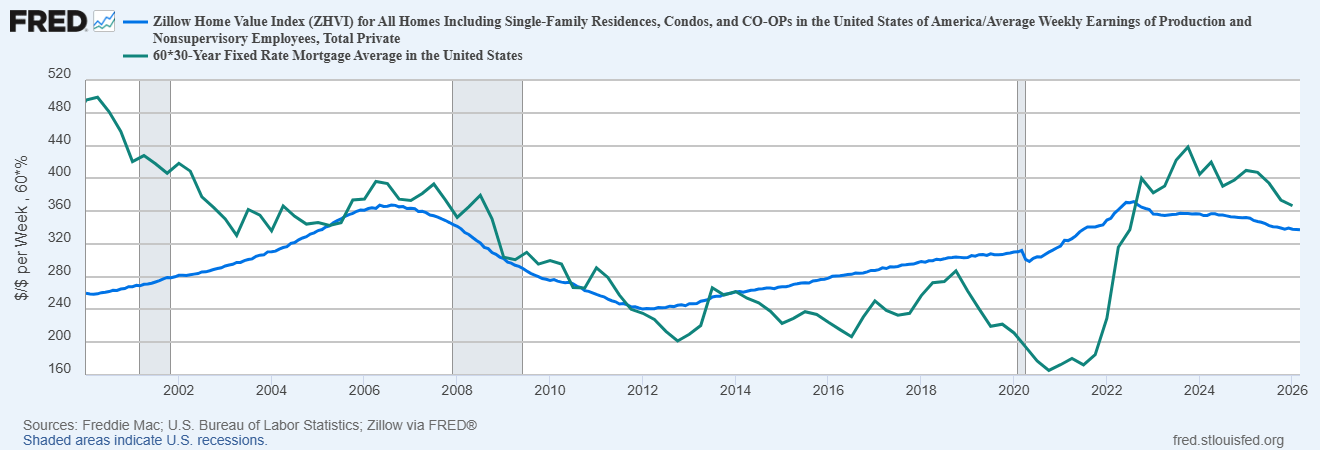
In 2000, and again in 2011-2013, an average worker could buy an average home with 5 years of earnings. In 2006 and 2022, it took more than 7 years. This implies that homes became 40% more expensive relative to wages. There is your affordability crisis!
Today, the ratio is still almost 7 years. Republicans should celebrate the deportation of millions of illegal aliens, who are draining the housing stock. They should finish the job by enacting national E-Verify to ensure illegal aliens are not employed.
Republicans should also stop the rapid purchase of American housing stock by foreign interests (such as Chinese around American military bases) and by investment firms. These steps should increase the housing stock and decrease housing costs.
Off-topic, I have put in a 25% trailing stop loss on my MU (Micron) position. Volatility should be expected, but one analyst wrote that the forward P/E ratio for MU is a low 8.
Isn't it odd that the period of work necessary to buy a house is closely parallel to mortgage rates? In a true market economy, as the prices of home rise (meaning less are sold) shouldn't the finance rates be falling to encourage buyers? What appears to be taking place is an effort by the Bankers Cabal (who also control builder/developers) to decimate the middle class by making them poor. As Klaus the louse (WEF) said: "You will own nothing and be happy."
Yes, I think the housing "bubble" is likely to collapse, along with the stock market and the value of the dollar.