

Vitamin D: are you getting enough?
Statistics gone wild

Disclaimer: I am not a physician. This article is educational in nature, and is not intended to diagnose, treat, or cure any disease. Please consult with your healthcare practitioner.
Vitamin D is an unusual vitamin. It has been claimed to be both a hormone and a steroid. Apparently, there are more receptors throughout our bodies for vitamin D than for any other molecule. On a related note, the most prevalent micronutrient deficiency is for vitamin D. Vitamin D is synthesized in our skin in response to the sun’s ultra-violet radiation. So if you live in a cold climate, or for cultural or religious reasons cover up your limbs year-round, your only source of vitamin D would be food or supplements.
The most bioavailable form of vitamin D is vitamin D3, cholecalciferol. How much D3 do you need per day? The US government recommends a daily value of 20 mcg (micrograms), which is equivalent to 800 IU (international units). The conversion ratio is 1 mcg = 40 IU.
How did they come to this conclusion? Researchers from the US Institute of Medicine studied two sets of data. The first set of data addresses what levels of vitamin D we need in our blood in order to prevent various diseases. The amount of vitamin D we need to prevent rickets is nowhere near enough to guarantee other forms of health.
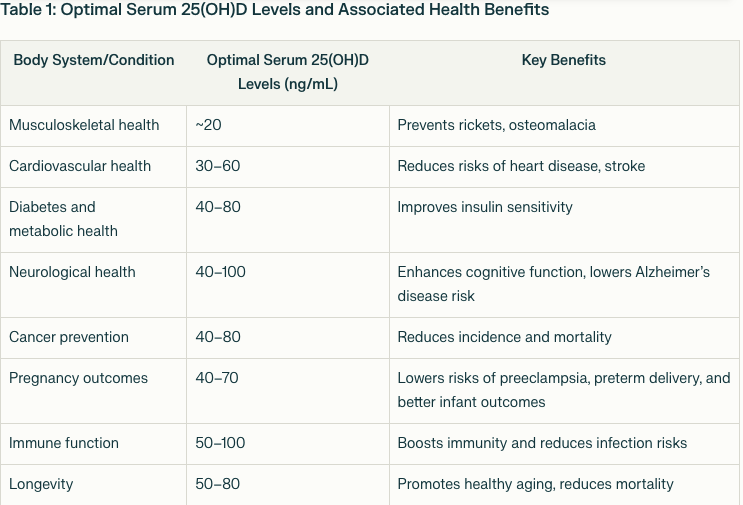
While the official reference range for 25-hydroxy-D is 30-100 ng/mL, better informed practitioners understand that 50 should be the true minimum, and others claim optimal health begins closer to 80. One should not go too far over 100, as this fat-soluble vitamin will begin to affect the liver adversely.
The next data set considered by the US IOM was that connecting patients’ intake of vitamin D (from food and supplement sources) with their corresponding blood levels. They were able to fit a reasonably good model to the data: such and such intake of vitamin D tends to be associated with such and such blood levels of vitamin D. The process of fitting of a theoretical model to observed data looks like this.
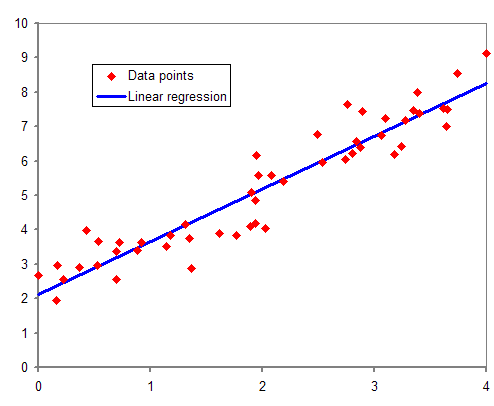
So far, so good. However, as you can see, in real life, most observations do not lie exactly on the line predicted by the model. This is where interval estimation comes in. Interval estimation constructs an interval where, for example, you might expect to find 95% of observations in real life. We never attempt to attain 100% certainty, because there are always outliers, unpredictability, and unknown factors in any situation.
The US IOM researchers thought it would be helpful to calculate what amount of vitamin D3 intake would be required to get at least 97.5% of patients over the minimum recommended blood level for vitamin D3 (50). The current guidelines are based on a 95% confidence interval. This interval excludes the 2.5% of people at the bottom and the 2.5% of people at the top. Presumably the people at the top are getting enough vitamin D, so the use of the 95% interval actually gets 97.5% of the population high enough.
There is just one little problem. The researchers used a confidence interval, which estimates the location of population means, rather than what they should have used, a prediction interval, which estimates the location of individual observations. This graph shows the difference.
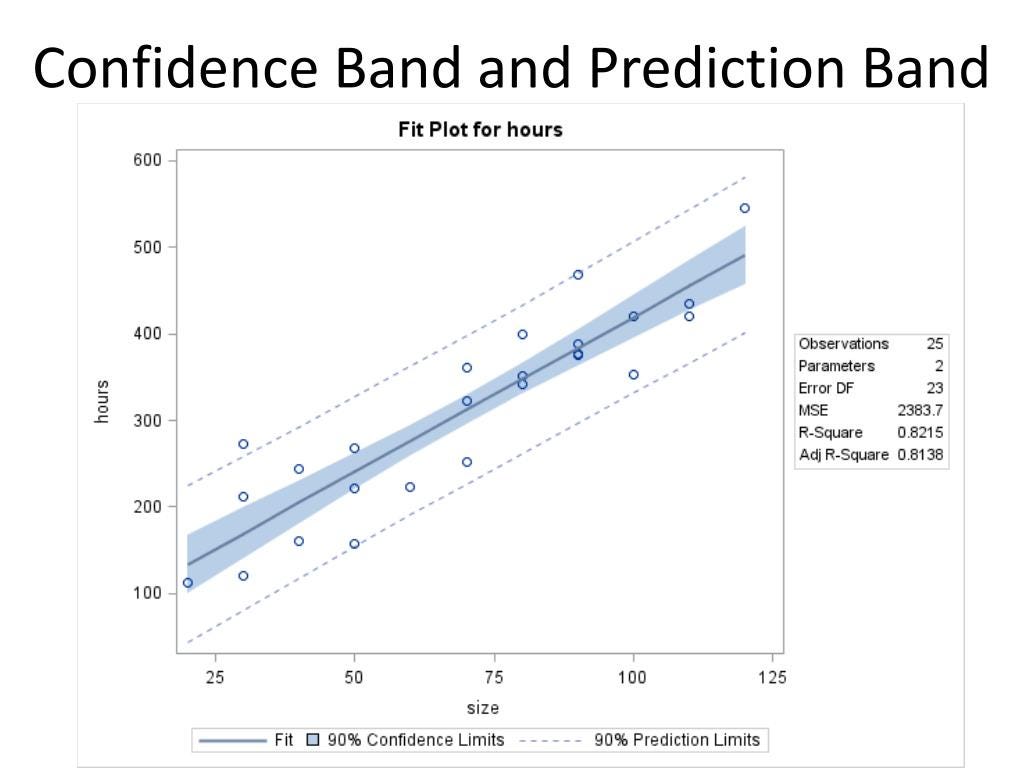
The observed data are little circles. The best-fit linear model is the solid line. The blue confidence band shows where population means are expected to lie: very close to the line. However, individual observations can be expected to vary considerably more than the population means, so the prediction band is the much wider space between the dashed lines.
Suppose your goal is to get hours, the quantity on the vertical axis, to be over 300. If you were lucky enough to have all points be exactly on the line, then you could just drop down to the horizontal axis, and announce that the size must be at least 70.
In real life, not all points are on the line. Since they might be below the line, if we want to be 95% certain of getting hours over 300, we could drop down to the lower edge of the blue band, and trace up to the right a bit. Maybe with size over 80, we could get hours over 300.
However, that would only get the population mean over 300 with 95% certainty. If your goal were to ensure that 95% of all individual observations were over 300 hours, you would need to move down further to the lower dashed line. Now we see that to get it over 300 hours, we must move even farther to the right, with size over 100.
This is just what happened with the vitamin D3 calculation. The current guidelines are designed to get the population average blood level over a desired goal (50) with 95% certainty. But to help 95% of all people get to that same goal, you need a much higher dose of vitamin D3.
You can read the details in two articles: 1) one published in 2014; and 2) one published in 2017. The articles never questioned the original data; they just did the correct statistical analysis that should have been done from the beginning.
The bottom line is that the Recommended Daily Allowance (RDA) of vitamin D3 was way too low at 600 IU; it should have been 8895 IU!
I have recently increased from 5000 IU to 6000 IU, with my blood level of 25-hydroxy-D now at 79. I like to be in the approximately 80-100 range, so this is a good result.
Vitamin D3 cannot be taken on its own. It needs cofactors to make sure you don’t calcify your tissues. 100 mcg of vitamin K2 is often joined with D3 at any dosage (the relationship is not proportional). This K2 will send calcium from your bloodstream to your bones.
The other important cofactor is magnesium, a very helpful mineral present in many green leafy vegetables. I supplement with it as well in the common citrate form, where it aids sleep.
Sunshine on your face and bare limbs (for a limited time each day) helps too!
I have read and enjoyed Jeff T. Bowles’s two books on vitamin D3. He is a self-educated amateur who can rattle off hundreds of studies at the drop of a hat.
Dr. Eric Berg offers some high-quality supplements and almost 6000 videos on his YouTube channel. The star supplement and most popular video topic are both vitamin D3.
What works for you? Let me know.
Surak, fine job on vitamin D. My comfort point seems to be 80, achieved with 10000 i.u. daily of D3. I used to get more D via the sun, but I'm not out there so much since COVID and, now, with the chemtrails overhead almost daily. Vitamin D is vital for our health to a degree most people are not aware of.
Dr Vernon Coleman was silenced, suppressed and blocked by Goolag and Fakebook for recommending that people who were locked down in their homes should take vitamin D which we get from being outside in the sun.
Just thought you would like to know that.